I admit it: I’m a fan of Star Trek. It started with The Next Generation when I was a teenager and we finally got cable TV. Deep Space Nine was next, followed by Voyager, only then The Original Series, and then the films.
I loved it then and I still love it today.
Of the many characters in the Star Trek universe, the one I love the most today is Nyota Uhura. Because when you really think about it, she is an absolutely amazing individual.
Uhura is not simply someone who «speaks languages.» Her extraordinary linguistic abilities are part of a much broader competence. Across the various Star Trek series, films and interpretations of the character, she is portrayed as having an impressive command of languages (she is fluent in 37 different Earth languages alone!), dialects and forms of communication.
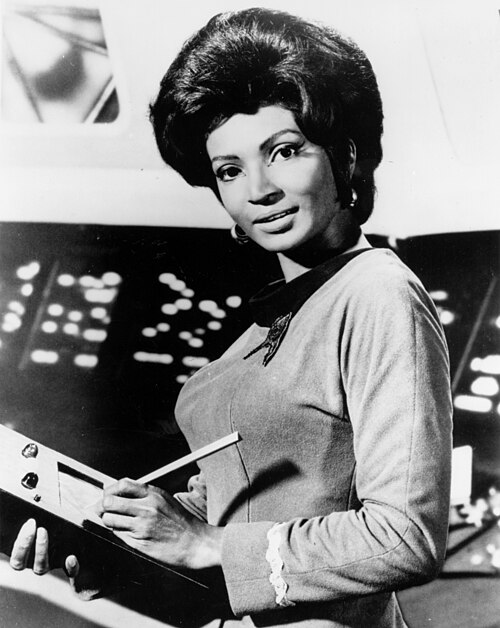
As the communications officer aboard the USS Enterprise, Uhura is the one opening channels, receiving transmissions and calmly announcing incoming messages from distant worlds. [Side note: She seems to be holding a notepad in the image, ready for consecutive interpretation?!] But her role represents something much bigger. Uhura is a powerful symbol of what language professionals do: they make communication possible across boundaries that would otherwise remain insurmountable.
And in an age of artificial intelligence, machine translation and increasingly sophisticated language technologies, her example may be more relevant than ever.
So what can a fictional communications officer teach us about the future of interpreting?
Quite a lot, actually.
What makes her so interesting today is that she works in a universe that already has something remarkably similar to the technology we are developing now: the Universal Translator.
The Universal Translator should have made Uhura redundant. It didn’t.
In the Star Trek universe, the Universal Translator can convert languages in real time, allowing humans and alien species to communicate despite having completely different linguistic backgrounds.
If we take that premise seriously, one might ask:
Why does the crew still need Uhura?
And this is where the science fiction becomes surprisingly relevant to our own technological reality.
Today, AI-powered translation and speech technologies are advancing at an extraordinary pace. Text can be translated almost instantaneously. Speech can be transcribed and translated in real time. Terminology can be identified and processed at a scale that would have seemed like science fiction only a few years ago.
We are, in some respects, building our own Universal Translator.
But Star Trek offers an important insight:
Translation technology does not eliminate the need for human understanding.
Interpretation is more than words
Professional interpreters know this instinctively.
Interpreting is not simply the substitution of words from Language A with words in Language B. It involves context, intention, register, tone, cultural references, ambiguity and human relationships.
A technically correct translation can still produce a communication failure.
A joke may need to be adapted rather than translated literally. A diplomatic formulation may carry implications that are not immediately visible in the words themselves. A speaker’s hesitation, irony or emotional emphasis may change the meaning of what is being said.
And sometimes the most important information is precisely what is not said.
This is where human professional judgement matters.
Uhura is therefore more than a fictional «Universal Translator with a pulse.» She represents the person who understands what communication is trying to achieve.
The interpreter as a bridge
The traditional metaphor of the interpreter as a bridge remains powerful.
A bridge does not simply move something from one side to the other. It connects two different environments while accounting for the terrain between them.
Interpreters do the same.
They enable people with different languages, cultures and perspectives to participate in the same conversation.
And this is why interpreting remains important even as technology becomes better at translating language.
In fact, there is an interesting paradox:
The better technology becomes at translating words, the more clearly we can see the value of everything that lies beyond the words.
What AI can — and cannot — replace
This does not have to be an argument against AI.
Quite the opposite.
AI can become an extraordinarily valuable tool for interpreters. It can support terminology research, preparation, transcription, documentation and information retrieval. It can reduce repetitive work and potentially allow language professionals to focus more of their time and expertise on the parts of communication that require human judgement.
The question should therefore not simply be:
Can AI translate this?
The better and more useful question is:
What kind of communication is taking place, and what does successful communication require in this instance?
For a restaurant menu, a quick machine translation may be perfectly adequate.
For a medical consultation, a diplomatic negotiation, a court hearing, an international conference or a sensitive business discussion, the stakes are very different.
The consequences of misunderstanding are different.
And so is the value of professional human interpretation.
Uhura’s enduring lesson
Perhaps this is why Nyota Uhura remains such an inspiring role model for interpreters.
She operates in a world where the technological solution to language barriers already exists — and yet her expertise still matters.
She reminds us that communication is fundamentally human.
Technology can help us cross linguistic boundaries. It can make communication faster, cheaper and more accessible.
But understanding another human being involves more than decoding a sequence of words.
It requires listening.
It requires judgement.
It requires cultural awareness.
And sometimes it requires another human being who knows when a translation is technically correct — but communicatively wrong.
The Star Trek Universal Translator may still be fictional.
Our own AI-powered version is becoming increasingly real.
But perhaps the lesson from Uhura is that we should not measure the future of interpreting by asking whether machines can translate.
We should ask what humans will continue to need in order to understand one another.
And that is a question worth exploring long before we reach the stars.
To all interpreters: keep the channel open.
Image: Wikimedia