Although I have met colleagues who really like consecutive interpreting (where one person speaks after another), the large majority (myself included) prefer simultaneous interpreting (where the interpreter speaks with just a little lag while the other person is talking), myself included.
Depending on the setting, simultaneous also seems to be the most frequently employed mode, at least for conferences and meetings, especially when time is of the essence and the natural flow of a lecture or discussion is not to be disrupted.
Of course, there are also many situations when consecutive is the better option, as it allows for questions and clarification, for example in court (to ensure clarity and understanding), during important talks or negotiations involving only a few people (to limit the risk of misunderstandings), or during guided tours.
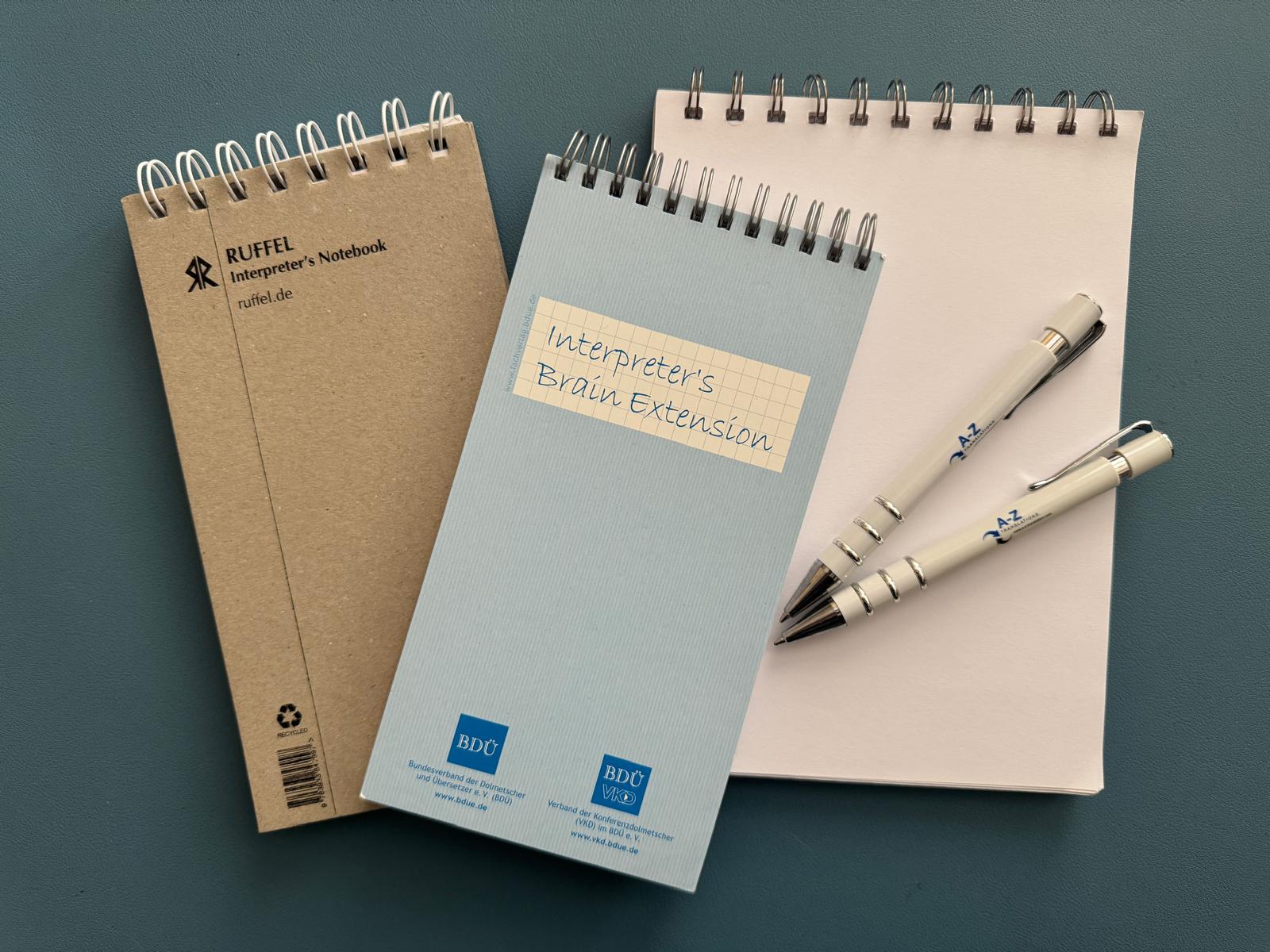
My students always complain that they have to learn the special notetaking technique required for consecutive interpreting, using pen and paper (although a tablet is also an alternative, as long as you know how to use it – and have sufficient battery for the duration of the assignment). Most of them love simultaneous and would not mind never having to take notes again.
However, even during an assignment set up for simultaneous interpreting only, you never know when you might have to pull out your notepad and pen and start interpreting in consecutive mode – as happened just recently during a two-day meeting of factory managers.
We were sitting in our booth, my colleague was happily interpreting, when suddenly everything went black and the sound coming through our headphones cut off. A power outage.
What had happened? A brief moment of confusion – apparently the whole section of the building where the meeting was taking place was affected. A quick fix seemed unlikely.
So my colleague grabbed notepad and pen and went to the front to where the current lecturer was looking through his notes. He decided he could go on with the reamining lecture without the presentation as there was not that much left, and she started to interpret consecutively, noting the most important things on her notepad.
This went on for maybe five minutes or so, then the technician had found the source of the power outage (a coffee machine had been plugged into an overused line and turned on for the next break, thus putting the electricty of the adjacent rooms out of commission) and rectified the situation. Lights came on, the interpreting system started working again, and the beamer tried to connect to the laptop. My colleague returend to the booth and interpreted the last few minutes of the lecture simultaneously before getting herself a well-deserved coffee.
So even when you think you’ll be safely ensconced in a nice cozy booth with sound coming through the headset during the next assignment, always be ready to switch to consecutive mode at a moment’s notice – the next power outage may only be a press of a button away.